

We are currently walking into a mental cul-de-sac. We tend to imagine the future in absolutes: utopia or dystopia, AI extinction or abundance, AI taking all our jobs or humans remaining irreplaceable.
But the more interesting question is not whether or not humans will be replaced.
It is: How are we replaceable? In which roles, and in which capacities?
Where will we remain irreducibly human?
I sometimes call this – the non-fungibility vector.
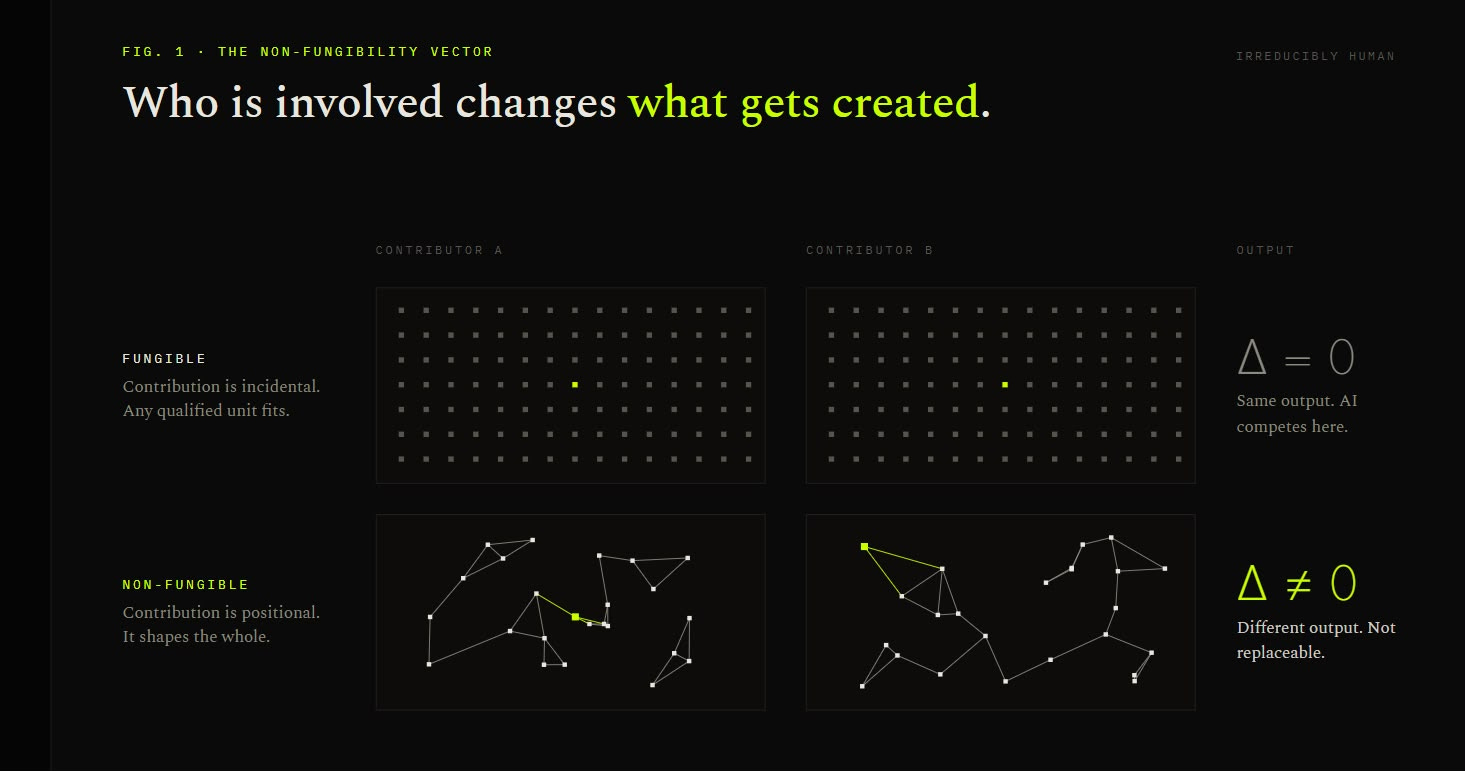
Humans – and AI for that matter – will always be replaceable wherever contribution is incidental. Wherever individual contributions are essentially a fungible unit of labor. Wherever it makes little difference whether I participated in creating something or someone else with roughly the same qualifications, expertise or experience.
In those situations, we compete directly with AI.
And as AI integrates more of the organizational, managerial and productive execution of cognitive work, an increasing share of what we currently call a “job” moves into a new synthetic economy.
The frontier is already making this visible.
Few humans can meaningfully compete with frontier AI on flat cognitive tasks – tasks where the objective is clear, the context can be supplied, and the work can be executed, verified, evaluated and reintegrated into the process through increasingly sophisticated reasoning.
The frontier is becoming less flat.
AI is moving beyond isolated, non-isomorphic tasks. It is adsorbing more historical context, reasoning across longer time horizons, forming hypotheses, identifying patterns, developing orientations and adapting its actions to increasingly complex conditions.
The deeper AI can reach into the past, and the further it can reason into the future, the more cognitive work becomes transferable. If what I contribute is essentially a task bundle that another qualified person could perform just as well, the task does not need me.
Humans are not strictly necessary for the process of building a house. They are not strictly necessary for the process of building many things.
However, that does not mean humans will not be needed – on the contrary:
Who is involved changes what gets created.
There are parts where building – let’s say a house – with AI may very well make it less economically viable than building it with meaningful human involvement.
A house designed by an architect doesn’t just look beautiful. It becomes meaningfully different because of that architect's view of the world, the professional depth and accumulated experience.
The same can be true in less obvious domains.
A family business may bring decades of local knowledge and relationships to the panels on the roof. An entrepreneur with a driving belief in the future may build a fundamentally different solar system. An electrician will have to take professional responsibility for the house’s electrical systems, its safety and its compliance with regulations. And a woodworker may work with natural materials that already contain irreducible complexity.
What matters is not simply that these people perform a task.
It is the particular thing that comes into existence because of their position.
Cognitive – and, in a few years, also overall physical labor – might very well resemble the Basketmaker of the industrial age: a romanticized idea of what the human touch adds to the overall product, preserved long after machines have become objectively better at producing it.
However, ensuring your value beyond 2030 means not simply becoming the accumulation of your role and its tasks. It means developing a contribution that is irreducibly you. You become, in a sense, an NFT of the labor market.
Only then will AI not replace you.
But elevate you.
Because everything you do will expand with AI into a multi-dimensional opportunity space: its execution cutting across massively siloed knowledge domains.
Everything that only you can bring to the table, not even AI can replace – but making sure it remains valuable will be a challenge.
This is what I call the Excellence Economy.
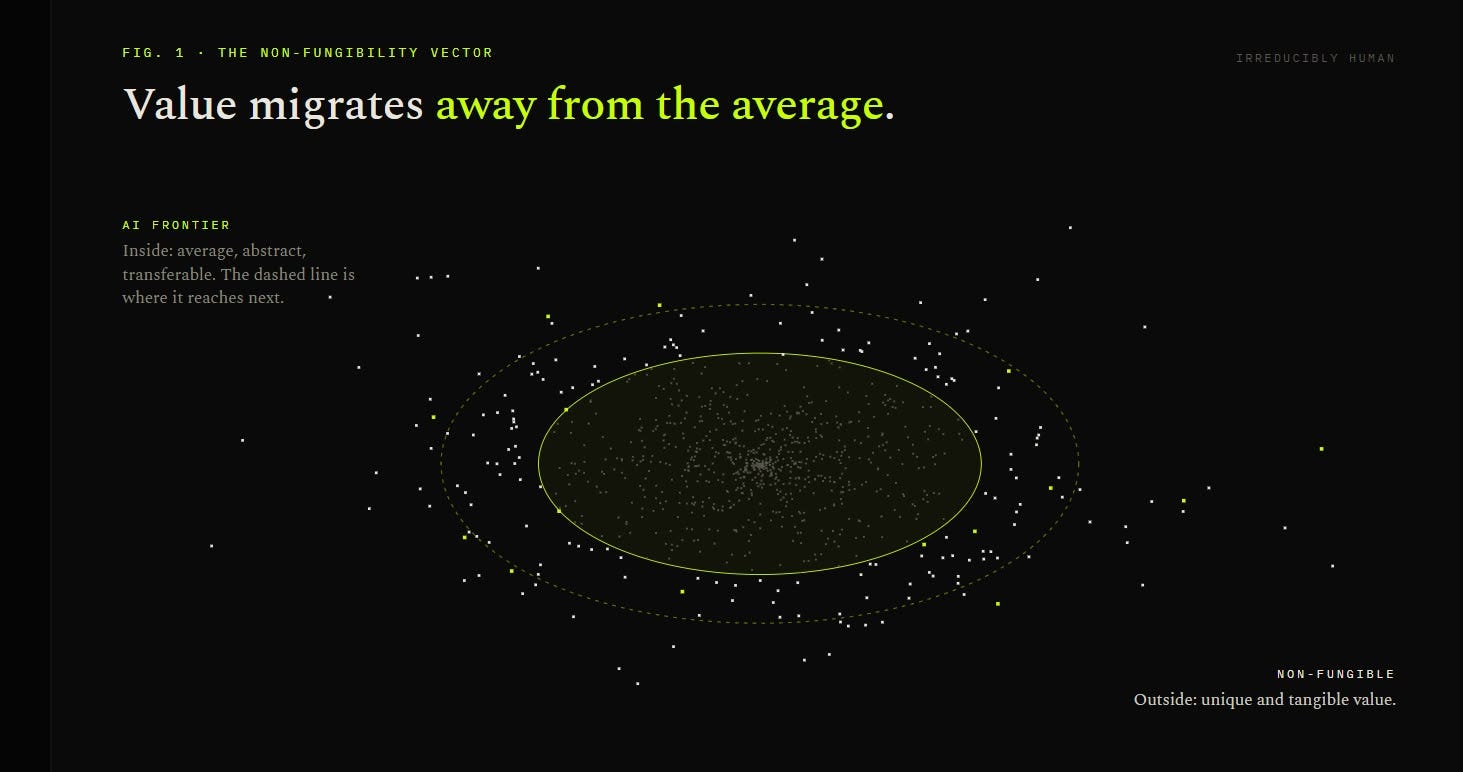
The value does not come from being average or abstract.
It comes from creating unique and tangible value.
It potentially extends far beyond authors, artists, performers, influencers or people whose work already depends visibly on their personality. Every individual accumulates a strange and highly specific fingerprint of capability throughout life. Over time, it recombines into an internal model of the world and a set of guiding principles.
It determines what we can contribute but it is non-deterministic.
We are the output of a unique distillation model running inside an individual human mind.
And that is – by definition – not average.
That is where, in the end, much of human economic value will migrate:
Non-fungible contribution – while remaining at the frontier of whatever you contribute to, curious about the disruption, willing to exercise judgment about what actually matters.
This will lead all of us down a path of three distinct future skills:
The What: Long-term orientation. With vision, service and taste.
The How: Knowledge distillation. With focus, depth and learning loops.
The Who you Build With: AI-native environment design. For grit, resilience and investment.
That does not mean many other capabilities will no longer matter.
The willingness to build with others and experiment in uncertainty. The ability to bridge the physical and digital worlds. The capacity for first-principles and systems thinking. Passionate problem solving and connecting things that previously belonged to separate domains.
But perhaps these are not separate skills after all.
They may all sit underneath something more fundamental.
Agency.
AI will inevitably expand the space of what is possible. It has already become an agent in our lives. But it does not replace our own agency.
The future will not divide neatly into humans and machines.
But into fungible and non-fungible contribution.