


For the past 30 years, we have built businesses around scarcity. Scarcity of information, capital, distribution, talent, technical capabilities, and access to markets.
Artificial intelligence is dismantling much of that scarcity. Yet much of our thinking about competitive advantage remains trapped in the logic of the digital age. We superimpose familiar concepts onto AI-native businesses — proprietary data, network effects, distribution, capital, regulatory barriers — as if they were permanent economic laws.
They aren't. They are products of a particular technological environment.
The defining question of the next decade is not which moats survive AI, but which underlying sources of scarcity remain when intelligence becomes abundant.
That is where value will migrate.
The first casualties will be advantages built on the assumption that producing something valuable requires resources that others cannot easily access.
Proprietary data is a case in point: Owning a unique dataset will no longer automatically constitute an insurmountable competitive advantage. Synthetic data and distillation are proving remarkably effective, while the cost of generating high-quality training material continues to fall. Not all proprietary data will become worthless, but simply owning information will become the floor, not the moat. A static dataset is a one-off advantage in a world increasingly capable of reconstructing it at marginal cost.
The same applies to content: When everyone can produce extraordinary content at negligible cost, content itself — even high-quality content — ceases to be scarce. Attention might remain scarce, but attention without trust, depth, or commitment is fragile. The advantage shifts from producing more to becoming someone worth listening to.
Network effects are equally vulnerable to disruption: The digital economy was built on the premise that a platform becomes more valuable as more people participate. But autonomous agents are changing how people navigate platforms, coordinate complexity, and make decisions. When agents can move seamlessly across services, human attention and decision-making become unreliable bottlenecks. Networks built primarily on keeping humans inside a proprietary environment may become impossible to defend.
The role of capital is changing, too: For decades, the dominant entrepreneurial playbook was to raise enormous amounts of money, acquire customers, build scale, and eventually figure out profitability. In the AI-native era, a small team can build products, automate operations, reach customers, and generate revenue with capabilities that previously required hundreds of employees. Capital still matters, but it increasingly amplifies intelligence rather than substitutes for it. When intelligence is cheap, knowing where to direct it matters more than simply having the resources to deploy it.
Audience and distribution will matter, but in a counterintuitive way: As technology moves complexity into the background, people will become less willing to spend their lives interacting with screens, reorienting their attention toward experiences that feel immediate, embodied, and meaningful. The most valuable distribution may therefore be that which does not maximize the amount of attention, but the quality of who is listening. The question changes from How many people can we reach? to How deeply do we matter to the people we reach?
Physical assets are no automatic refuge either: A traditional company that refuses to connect its physical capabilities to the intelligence revolution is not protected by its physical presence. It risks tying its legacy business to an operating model that becomes progressively less competitive. The value of a factory, a hospital, or a logistics network lies not simply in owning it, but in the ability to make it perform differently.
Human connection is another comfortable assumption that deserves challenging: Human connection will not automatically become more valuable as AI becomes more capable. The digital age has produced an extraordinary atomization of individuals, many of whom are deeply longing for connection. An AI companionship may prove easier, more responsive, and dramatically more convenient than human relationships. Not everyone can afford to pay a premium for human interaction. And simply being human is not a robust value proposition.
Even regulatory complexity will prove a weaker moat than incumbents expect: AI will reduce the cost of navigating compliance, documentation, and administrative requirements. Barriers that once demanded years of specialized work will become substantially easier to navigate.
Advantages built on friction, inefficiency, and artificially constrained access are becoming less defensible. In the next decade, the value of a business depends on whether its underlying advantage survives the disappearance of the conditions that created it.
And it changes what counts as a competitive advantage.
The new moats: What becomes scarce, what cannot be scaled?
Where does economic value migrate in a synthetic economy?
Toward that what resists frictionless replication — what cannot simply be regenerated, copied at negligible cost, or deployed without consequence or effort.
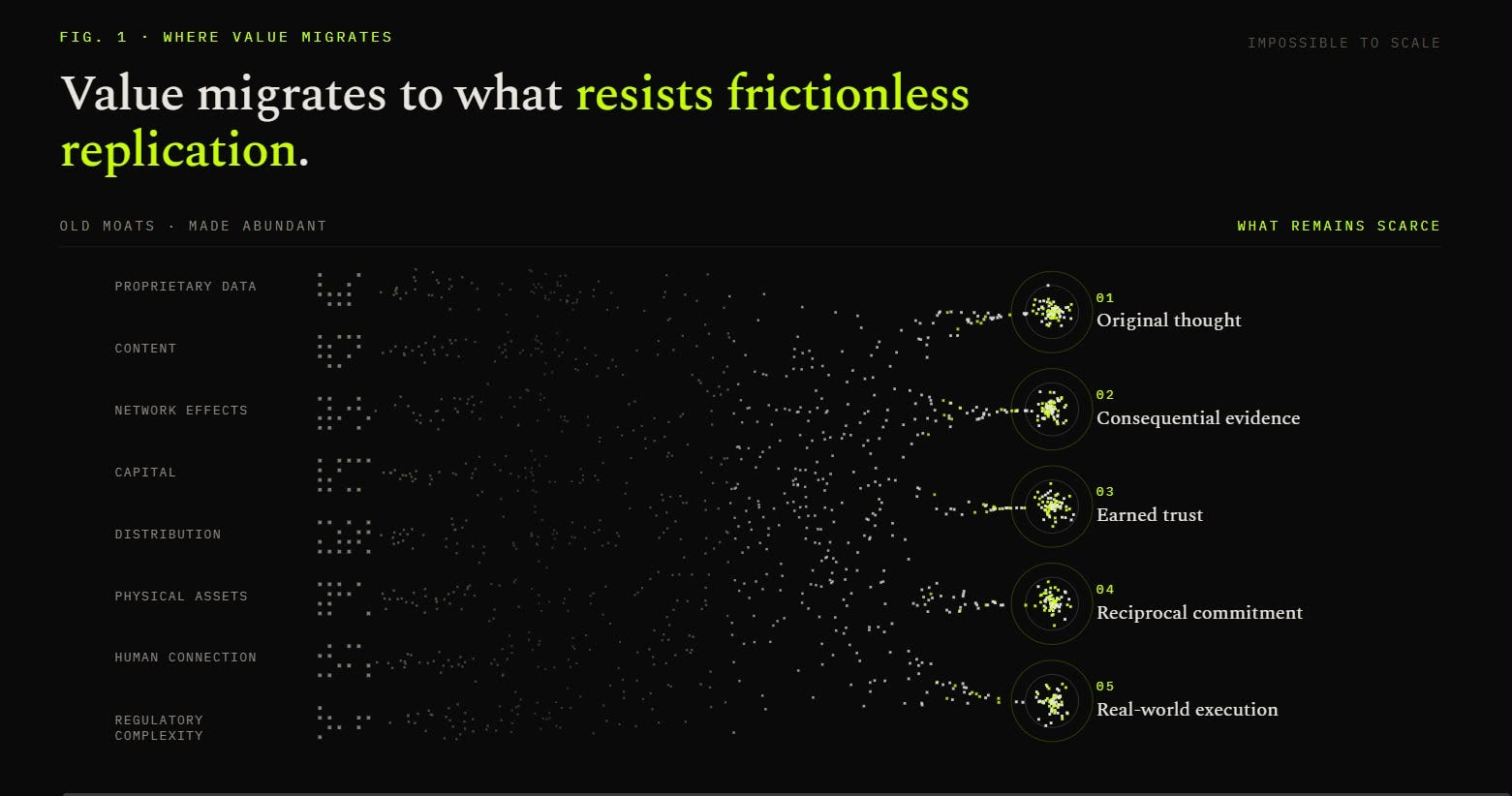
1. Original thought and N=1 contribution: Producing something that genuinely expands the available possibilities rather than merely recombining what already exists. Developing a distinctive understanding of what is driving change, and the ability to identify consequential insights in an ever-expanding opportunity space.
As intelligence advances, the bar rises. The advantage belongs less to those who can keep up with the frontier of intelligence but those who are still able to judge its ever more alien outputs.
2. Access to consequential evidence
Synthetic information can approximate reality, but it cannot automatically substitute for access to reality itself. Some of the most valuable data emerges from consequential decisions, reasoning over real-world outcomes, and the verification of situations in which information is incomplete, misleading, reactive, or simply unavailable.
The ability to generate useful context that others cannot easily reconstruct becomes a massive source of advantage. This includes proprietary feedback loops, hard-to-observe behavior, and the accumulated knowledge of what actually happens when a model meets the world.
3. Earned trust
Not brand awareness purchased through distribution, but confidence earned through experience: the belief that an organization is competent, reliable, and aligned with your interests, values, and long-term goals — including when acting in your interests comes at a cost to the organization itself.
AI can manufacture the appearance of credibility at scale. It can reproduce a voice, personalize a message, and simulate the signals through which trust is usually established. However, it makes the difference between perceived credibility and demonstrated reliability more consequential than ever.
4. Reciprocal commitment
Reciprocity in relation means more than the experience of being understood. It means making commitments with someone whose ability to make choices resembles yours.
In business, this takes the form of shared risk, real partnership, human scale accountability, and the willingness to create something larger than oneself together.
As autonomous outreach floods our interactions with low quality bids for transactional attention, genuine commitment will become more carefully guarded. The scarce resource will be the willingness of another person to invest something consequential into you and to participate in something meaningful beyond themselves.
5. Real-world execution
AI expands the space of what can be imagined, designed, and coordinated. But intelligence alone does not build housing, deliver healthcare, manufacture products, secure energy supplies, or transform physical infrastructure.
The opportunity lies in building the bridge between the velocity of bits and the impact they can have on atoms.
The advantage is not simply owning physical assets. It is the ability to translate intelligence into meaningful changes in the real world: the systems through which ideas become outcomes.
This is where the extraordinary possibility space of the AI era meets the enduring constraints of the material world. And it is where some of the most consequential businesses of the next decade may emerge.
These advantages are not necessarily impossible to scale. But they resist the frictionless replication that AI introduces into the future. They require original insight, agency in the real world, trust earned over time, reciprocal commitment, or the ability to verify the frontier.
Beyond the cult of scale
These shifting foundations of value will also transform how we define success.
The iconic founder of the digital age was someone who sacrificed everything to build a billion-dollar company. Permanently busy, relentlessly ambitious, exhausted, and operating at the edge of their capability. Someone celebrated for working harder than anyone else, employing thousands, and building an organization whose size surpassed anything that came before.
But building a successful company in the AI era no longer requires building an organization enormous in size. A handful of people, equipped with extraordinary intelligence, can create products and services that previously would have required hundreds of employees and years of organizational development.
When the capacity to create value becomes less dependent on the capacity to accumulate people, capital, and organizational complexity, the relationship between ambition and scale begins to change.
A different entrepreneurial ideal becomes possible.
A small team of people who genuinely enjoy working together. A business that solves a meaningful problem. The freedom to live somewhere beautiful, spend time with friends, be in nature, pursue personal goals alongside professional ones, and decide freely how to structure one's days.
Not necessarily a billion-dollar exit. But a life worth living — and one that could become attainable for far more people than the top one percent.
This does not mean ambition disappears. It means ambition redirects.
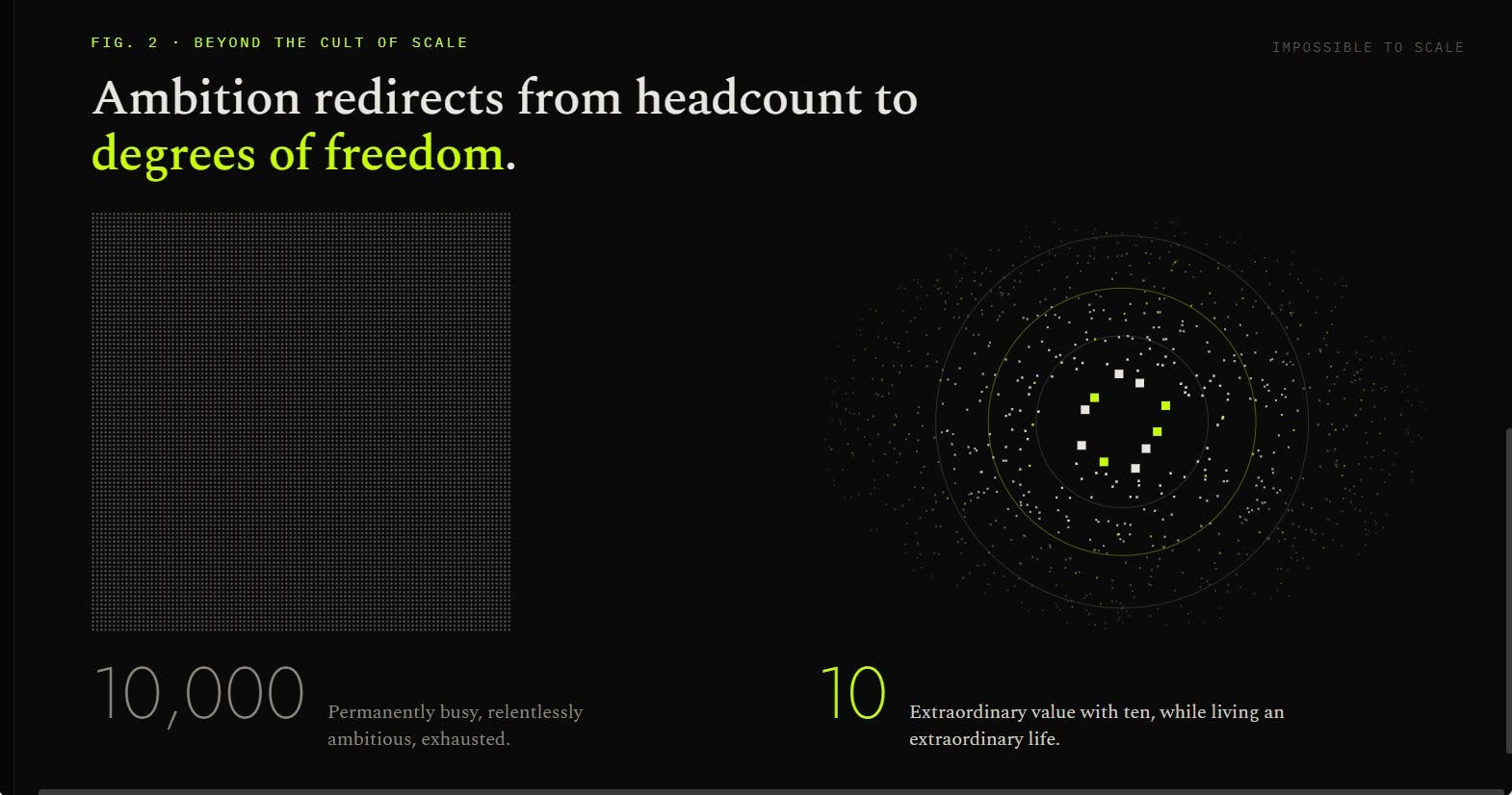
The new entrepreneurial status symbol will no longer be how much money you accumulate, but how many degrees of freedom you retain.
The most admired founder will therefore be no longer the person who employs 10,000 people, but the person who creates extraordinary value with ten — while living an extraordinary life.
Someone who builds something that matters.